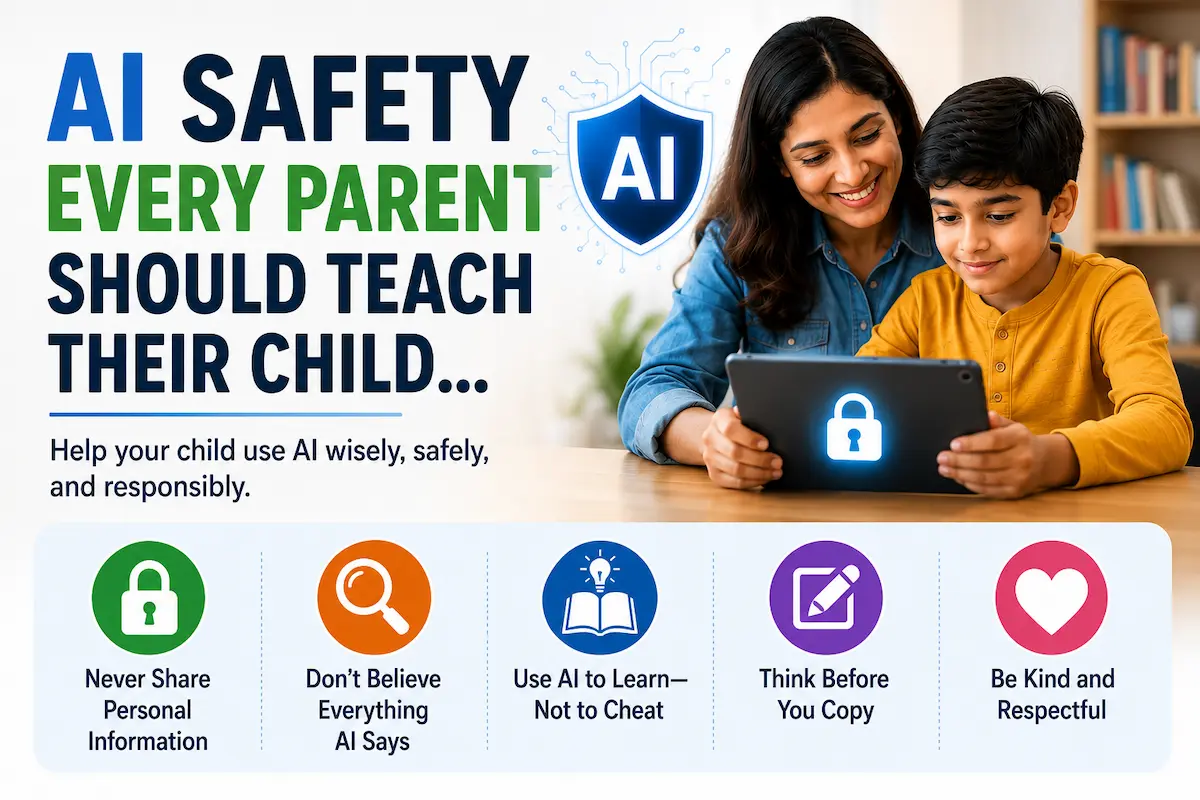

Artificial Intelligence is becoming part of everyday life. Many children are already using ChatGPT for homework, school projects, and learning new topics.
The important question isn’t whether children should use AI—it’s how they should use it.
A good prompt encourages thinking, creativity, and curiosity.
A poor prompt encourages copying.
Here are ten ChatGPT prompts every parent should teach their child to make AI a learning partner instead of a shortcut.
- Explain It Like I’m 10 Years Old

Prompt
Explain this topic like I’m 10 years old using simple words and everyday examples.
Why it works
Children often struggle because textbooks use difficult language.
Instead of becoming frustrated, they can ask ChatGPT to simplify the lesson while still learning the concept.
This builds understanding rather than memorization.
💡 Parent Tip
Encourage your child to ask follow-up questions until they truly understand the topic.
2. Guide Me, Don’t Give Me the Answer

Prompt
Don’t tell me the answer. Ask me questions that help me figure it out myself.
Why it works
Critical thinking develops when children solve problems on their own.
Instead of replacing their effort, AI becomes a coach that provides hints and guidance.
This approach builds confidence and long-term learning.
💡 Parent Tip
Praise effort and problem-solving—not just correct answers.
3. Quiz Me Before My Test

Prompt
Create a 10-question quiz about this chapter and explain any answers I get wrong.
Why it works
Practice quizzes strengthen memory and help children identify areas where they need more study.
AI can become a personal tutor that adapts to their learning pace.
💡 Parent Tip
Ask your child to explain each answer aloud. Teaching reinforces learning.
4. Check My Homework, Don’t Rewrite It
Prompt
Check my homework for mistakes and explain what I should improve without rewriting it for me.
Why It Works
Children learn best by understanding their mistakes rather than copying perfect answers. ChatGPT becomes a helpful teacher that points out errors and explains how to improve while allowing the child to complete the work independently.
💡 Parent Tip:
Encourage your child to correct the mistakes themselves after reading the explanation.
5. Help Me Brainstorm Ideas

Prompt
Give me five creative ideas for my project without doing the project for me.
Why it works
Creativity grows when children generate their own ideas.
AI should inspire imagination—not replace it.
The best projects still come from the child’s own thinking.
💡 Parent Tip:
Encourage your child to combine multiple ideas into something unique.
6. Explain My Mistakes
Prompt 1
I got this question wrong. Can you explain why and show me how to solve it correctly?
Prompt 2
Explain this topic one step at a time. Ask if I’m ready before moving to the next step.
Why It Works
Learning becomes more effective when children understand why they made a mistake and move through difficult concepts at a comfortable pace. Instead of rushing to the answer, AI acts like a patient tutor.
💡 Parent Tip:
Let your child solve the next similar question without AI to reinforce learning.
7. Teach Me One Step at a Time
Prompt
Explain this topic one step at a time. Ask if I’m ready before moving to the next step.
Why It Works
Every child learns differently. Some understand new concepts quickly, while others need more time and practice. Breaking a lesson into small, manageable steps helps children build confidence instead of feeling overwhelmed. By checking if they’re ready before moving on, ChatGPT creates a learning experience that matches the child’s pace.
💡 Parent Tip:
Encourage your child to pause after each step and explain it back in their own words before continuing.
8. Give Me Real-Life Examples
Prompt
Show me how this lesson is used in everyday life.
Why It Works
Children often ask, “Why do I need to learn this?” Connecting school lessons to real-life situations makes learning more interesting and easier to remember. Whether it’s using fractions while baking, science while gardening, or math while shopping, practical examples help children understand the value of what they’re learning.
💡 Parent Tip:
Ask your child to find one real-life example of today’s lesson at home or during everyday activities.
9. Challenge My Thinking
Prompt
Ask me three questions that make me think more deeply about this topic.
Why It Works
Learning isn’t just about remembering facts—it’s about thinking critically. Challenging questions encourage children to analyze ideas, make connections, and explain their reasoning. This develops curiosity, problem-solving skills, and the confidence to think independently instead of relying on ready-made answers.
💡 Parent Tip:
Let your child answer first, then ask, “Why do you think that?” to encourage deeper thinking.
10. Help Me Become a Better Learner
Prompt
Based on today’s learning, what should I practice next to improve?
Why It Works
The best learners are always looking for ways to improve. This prompt encourages children to reflect on what they’ve learned, identify areas they need to strengthen, and set small goals for future learning. It shifts the focus from simply getting good grades to building lifelong learning habits.
💡 Parent Tip:
At the end of each study session, ask your child to choose one small goal to practice before the next lesson.
The Golden Rule: Use AI as a Coach, Not a Shortcut

Children who use AI wisely will develop stronger learning habits than those who simply copy answers.
Teach your child this simple rule:
❌ Don’t ask AI to do your work.
✅ Ask AI to help you understand your work.
That one habit can make a lifelong difference.
Key Takeaways
- AI works best as a learning assistant, not a replacement for effort.
- Better prompts lead to better learning experiences.
- Parents play a key role in teaching responsible AI habits.
- Curiosity, creativity, and critical thinking will always matter more than simply getting the right answer.
Which ChatGPT prompt do you think would help your child the most?
Share your thoughts in the comments—we’d love to hear how your family uses AI for learning.