AI is becoming a normal part of children’s everyday lives. Children may use ChatGPT and other AI tools to ask questions, complete homework, explore ideas, or simply have a conversation.
AI can be incredibly useful—but parents should also pay attention to how much children rely on it.
The goal isn’t to keep AI away from children. Instead, children need to learn that AI should support their learning and curiosity, not replace parents, friends, teachers, books, or real-life experiences.
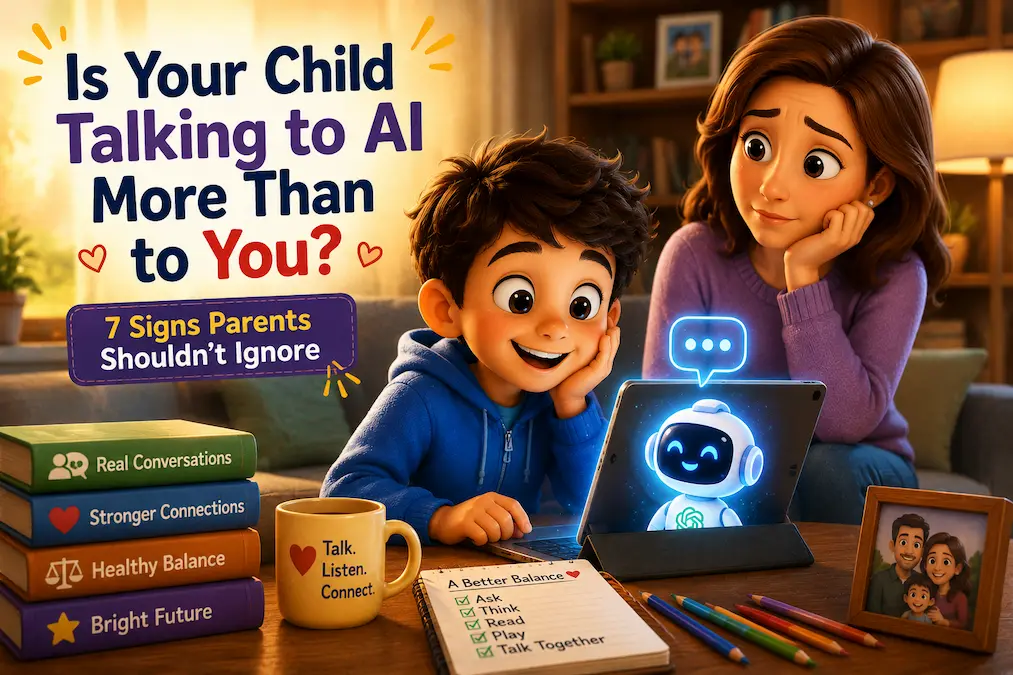
Here are 7 signs parents should watch for and some simple ways to create a healthier balance.
1. They Ask AI Before Asking You

Children naturally ask parents questions when they are curious. But if AI becomes their first choice for every question, parents may miss valuable opportunities for conversation and connection.
A simple question like “Why is the sky blue?” can become a wonderful conversation between a parent and child.
AI can provide an answer—but the conversation around that answer is just as valuable.
💡 Parent Tip
Teach your child this simple rule:
Think first. Try second. Ask AI third.
2. They Stop Solving Problems on Their Own

One of the biggest concerns isn’t that children use AI—it’s when they stop trying before asking AI.
If a child immediately asks AI to solve every math problem, write every paragraph, or explain every difficult question, they may miss the most important part of learning: the effort of figuring things out.
Children need opportunities to struggle a little, make mistakes, and discover solutions.
💡 Parent Tip
Instead of saying, “Don’t ask AI,” try:
“What do you think the answer is? Let’s talk about it first, and then we can check AI together.”
3. They Spend More Time With AI Than With People
But children still need real conversations with parents, siblings, friends, and teachers. These relationships help children develop communication, empathy, cooperation, and emotional understanding.
AI can simulate a conversation, but real relationships teach children how to understand real people.
💡 Parent Tip
Create regular technology-free moments such as family meals, evening walks, reading time, or conversations before bedtime.
4. They Believe Everything AI Says
AI can provide impressive answers, but it isn’t always correct.
Children need to understand that an AI-generated answer isn’t automatically a fact. Learning to question information is becoming one of the most important skills children can develop.
Teach your child to ask:
- Is this information correct?
- Where did it come from?
- Can I verify it somewhere else?
- Does my textbook or teacher say the same thing?
💡 Parent Tip
Turn fact-checking into a game. Give your child an AI answer and ask them to find out whether it is accurate.
5. They Lose Interest in Books and Other Activities

Reading, drawing, playing outside, building things, and exploring the real world are still essential parts of childhood.
If AI and screens begin replacing these activities, children may lose opportunities to develop imagination, concentration, creativity, and physical skills.
💡 Parent Tip
Create a simple daily balance:
AI + Books + Play + Family Time + Outdoor Activities
Children don’t need to choose between technology and real life. They need a healthy combination of both.
6. They Become Frustrated Without AI
Try asking your child to complete a simple task without AI.
If they immediately say, “I can’t do it without ChatGPT,” it may be a sign that they are becoming too dependent on technology.
AI should make children more capable, not less capable.
A child should gradually become confident enough to think, write, calculate, research, and solve age-appropriate problems independently.
💡 Parent Tip
Have occasional AI-free learning sessions where your child solves a problem using only their own knowledge, books, and notes.
7. Family Conversations Become Less Frequent

One of the simplest signs to notice is also one of the most important.
Are family conversations becoming shorter?
Is your child spending more time talking to a screen than talking to family members?
Are devices present during meals, bedtime, or family activities?
Technology should never become a substitute for family connection.
💡 Parent Tip
Create a daily 10-minute family conversation with all devices put away.
Ask simple questions:
“What was the best part of your day?”
“What did you learn today?”
“What made you laugh?”
Sometimes the simplest conversations create the strongest connections.
Healthy AI Habits Every Family Can Follow
Instead of completely banning AI, create simple family rules.
✅ Think Before Asking AI
Give your child time to try solving the problem independently.
✅ Use AI as a Learning Assistant
AI should explain, guide, question, and encourage—not simply complete the work.
✅ Verify Important Information
Teach children that AI can make mistakes.
✅ Keep Reading
Make books and independent reading part of everyday life.
✅ Protect Family Time
Keep certain times and places screen-free.
✅ Encourage Real-World Experiences
Playing, talking, creating, exploring, and experimenting are just as important as digital learning.
A Simple AI Balance Rule
You can teach your child this easy rule:
AI should help you become better at thinking—not do all the thinking for you.
Before using AI, ask:
“Can I try this myself first?”
After using AI, ask:
“What did I actually learn?”
And finally:
“Can I do something similar without AI?”
These three questions can help children develop healthier AI habits.
Final Thoughts
AI isn’t the enemy.
In fact, it can become one of the most useful learning tools available to children.
The real goal is to help children develop the judgment to know when AI can help and when they should think, explore, talk, read, or solve the problem themselves.
Children don’t need less curiosity.
They need more curiosity—with the right balance of technology and real life.
💬 Discussion Question
Do you think your child is becoming too dependent on AI?
What rules do you have at home to balance AI, screen time, family conversations, reading, and outdoor activities?
Share your thoughts in the comments.