A practical guide to helping children use artificial intelligence safely, responsibly, and thoughtfully.
Artificial Intelligence Is Already Part of Childhood
Artificial intelligence is becoming part of everyday life—and children are growing up surrounded by it.
They see AI in search engines, educational apps, games, writing tools, chatbots, and even in the tools their schools use.
That leaves many parents asking an important question: At what age should my child start using AI?
There isn’t one perfect age for every child. A child’s maturity, purpose for using AI, ability to understand that AI can make mistakes, and level of parental supervision all matter.
The goal shouldn’t be to keep children away from AI forever. The goal is to help them learn how to use it safely, thoughtfully, and responsibly.

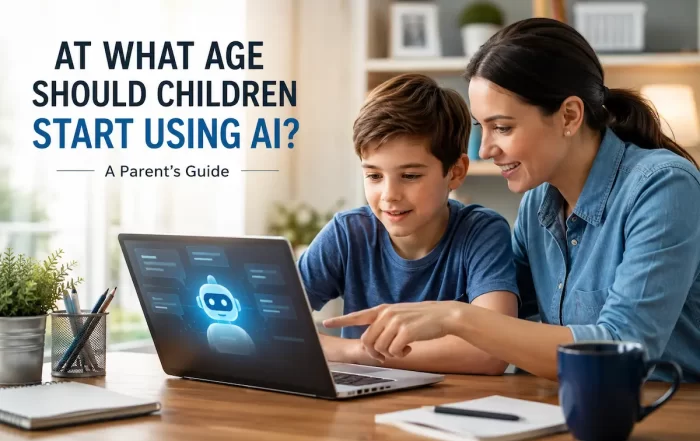
Parent and Child Exploring AI Together
AI can become a learning tool when children are taught how to question and evaluate it.
Is There a “Right” Age to Start Using AI?
Not really.
Different AI tools have different age requirements, and parents should always check the current rules of the particular service before allowing a child to use it.
But age alone shouldn’t determine whether a child is ready.
A child who is ready to use AI should gradually be able to:
- Understand that AI isn’t a human.
- Recognize that AI can give incorrect information.
- Ask questions instead of blindly accepting answers.
- Protect personal information.
- Tell an adult when something feels confusing or uncomfortable.
- Use AI as a learning tool rather than simply asking it to do everything.
These skills are often more important than the number on a birthday cake.
👶 Ages 5–7 : Start With Guided Experiences
For young children, parents generally shouldn’t think about AI as something children need to use independently. Instead, AI can become something parents explore together with their child.
For example, a parent might ask an AI tool to:
- Create a simple bedtime story.
- Explain why rain happens.
- Suggest a drawing idea.
- Create a simple guessing game.
- Help answer a child’s curiosity.
The important part is that the parent remains involved.
Instead of handing a child a device and saying, “Ask AI,” try: “Let’s ask it together and see what it says.” Then talk about the answer.
This teaches an important lesson early: AI is a tool we can explore—not an authority that knows everything.
🧒 Ages 8–10 : Teach AI Literacy
Around elementary-school age, children may become increasingly curious about AI. They may encounter AI through schoolwork, search engines, games, or conversations with friends. This is a good time to begin teaching basic AI literacy.
Children should learn three simple ideas:
- AI Can Be Wrong
AI can produce an answer that sounds completely confident while still being incorrect.
Teach children to ask: “How can we check this?”
- Don’t Share Private Information
Children should understand that they shouldn’t casually enter sensitive information into AI tools.
That includes things such as:
- passwords
- home addresses
- phone numbers
- private school information
- financial information
- private photographs
- other people’s personal information
- AI Shouldn’t Do All the Thinking
If a child asks AI every question immediately, they can miss the opportunity to think, wonder, experiment, and solve problems independently.
Try this family rule: Think first. Ask AI second. Check third.
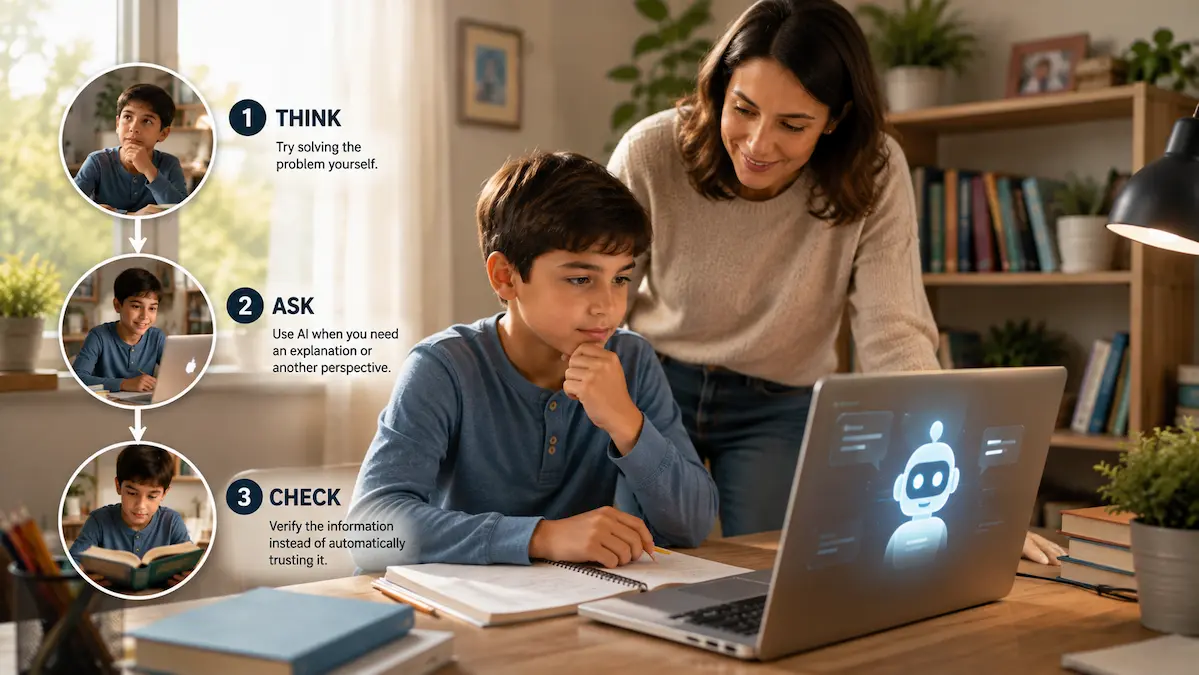
Teach Kids to Think Before Using AI
Think first, ask AI when needed, and always check important information.
👦 Ages 11–13 : Introduce More Independent Use
As children become older, they may begin using AI for more complicated tasks.
They might use it to:
- brainstorm ideas
- explain difficult concepts
- practice vocabulary
- generate quiz questions
- explore subjects they’re interested in
- organize ideas for a project
- get feedback on their writing
This can be useful—but parents should establish boundaries. For example:
AI can explain my homework.
AI cannot do my homework for me.
That distinction is extremely important. A child who asks: “Explain fractions in a way I can understand.” is using AI as a tutor.
A child who asks: “Give me the answers to my worksheet.” is using AI as a shortcut.
Those are very different learning experiences.
🧑 Ages 14+ : Teach Responsible Independence
Teenagers will likely encounter increasingly sophisticated AI tools. At this stage, completely banning AI may not teach them how to handle it responsibly.
Instead, parents can focus on judgment. Discuss questions such as:
- Is this information trustworthy?
- Where did this answer come from?
- Could the AI be biased?
- Is using AI allowed for this assignment?
- Am I actually learning?
- Am I using someone else’s private information?
- Could this response hurt someone?
- Should I verify this before sharing it?
The objective is to move gradually from parent-controlled use toward responsible independent use.
“Think First. Ask AI. Check Third.”
Make this a visual section.
🧠 THINK
Try solving the problem yourself.
🤖 ASK
Use AI when you need an explanation or another perspective.
🔎 CHECK
Verify the information instead of automatically trusting it.
Signs Your Child May Not Be Ready
Age isn’t the only factor. Consider slowing down if your child:
- believes everything AI says
- becomes frustrated when AI doesn’t give the desired answer
- uses AI to avoid thinking
- tries to hide AI use from you
- shares personal information
- uses AI to complete schoolwork dishonestly
- becomes emotionally dependent on an AI tool
- doesn’t understand why AI answers need to be checked
In these situations, the answer isn’t necessarily “No AI.” It may be: “Let’s learn how to use it properly first.”
What Kids Should Never Share With AI
Children should learn that an AI chatbot isn’t a private diary.
They should avoid sharing sensitive or unnecessary personal information, including:
- Passwords
- Home addresses
- Phone numbers
- Financial information
- Private photographs
- Private information about family members
- School or account credentials
When children aren’t sure whether something is safe to share, teach them to ask a parent or trusted adult first.
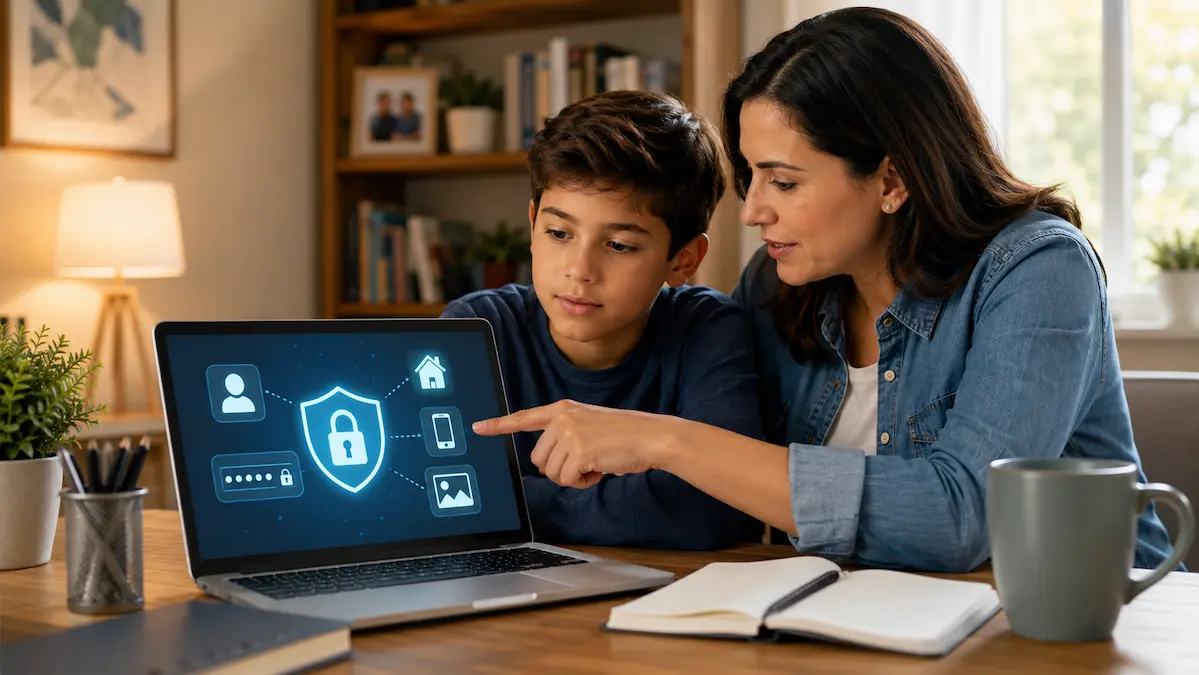
Kids and AI Privacy
Children should learn early that personal and sensitive information should be protected online.
Parent Reminder: Teach children that an AI chatbot isn’t a private diary. When in doubt, don’t share it.
AI Homework Helper vs. Homework Replacer
One of the biggest questions parents face is homework. AI can be helpful when it supports learning.
✅ AI AS A LEARNING TOOL
AI can help a child:
- Understand a difficult concept
- Practice a new skill
- Generate practice questions
- Understand mistakes
- Brainstorm ideas
- See another example
- Learn at their own pace
❌ AI AS A SHORTCUT
AI becomes a problem when a child uses it to:
- Complete an entire assignment
- Write an essay they were supposed to write
- Provide answers to a worksheet
- Do the thinking for them
- Pretend they completed work themselves
The goal isn’t to prevent children from using useful technology. It’s to make sure they are still learning.
AI can be a tutor. It shouldn’t become a substitute for learning.
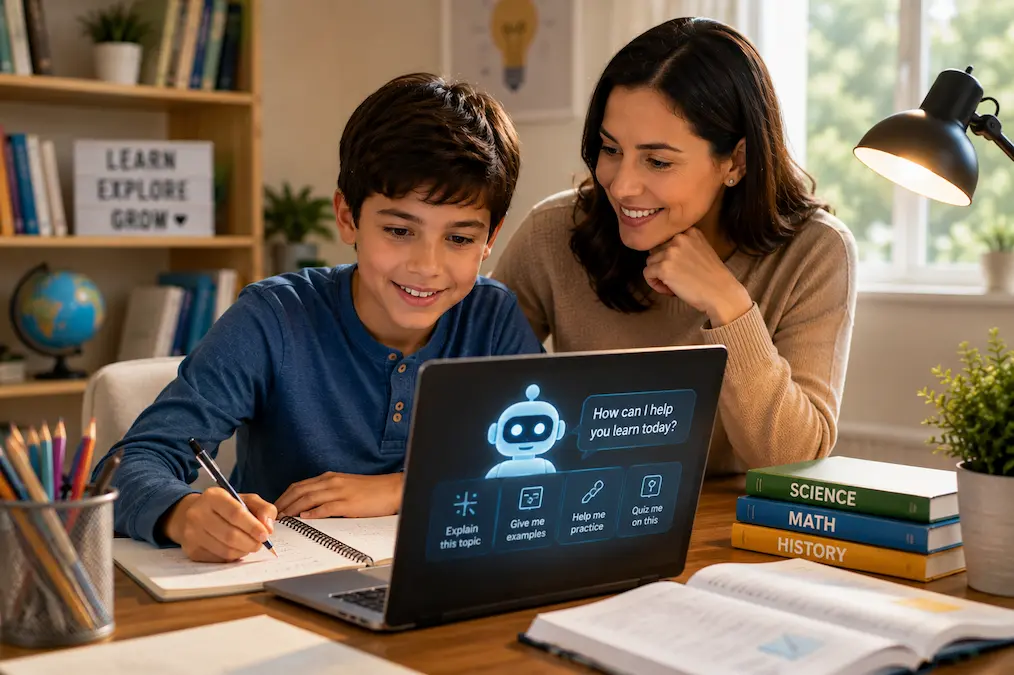
AI as a Homework Learning Tool
The best use of AI for homework is to support learning—not replace the child's own work.
The Family AI Five
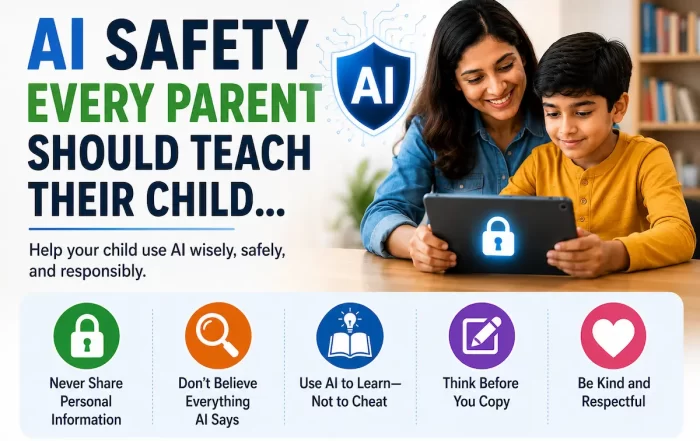
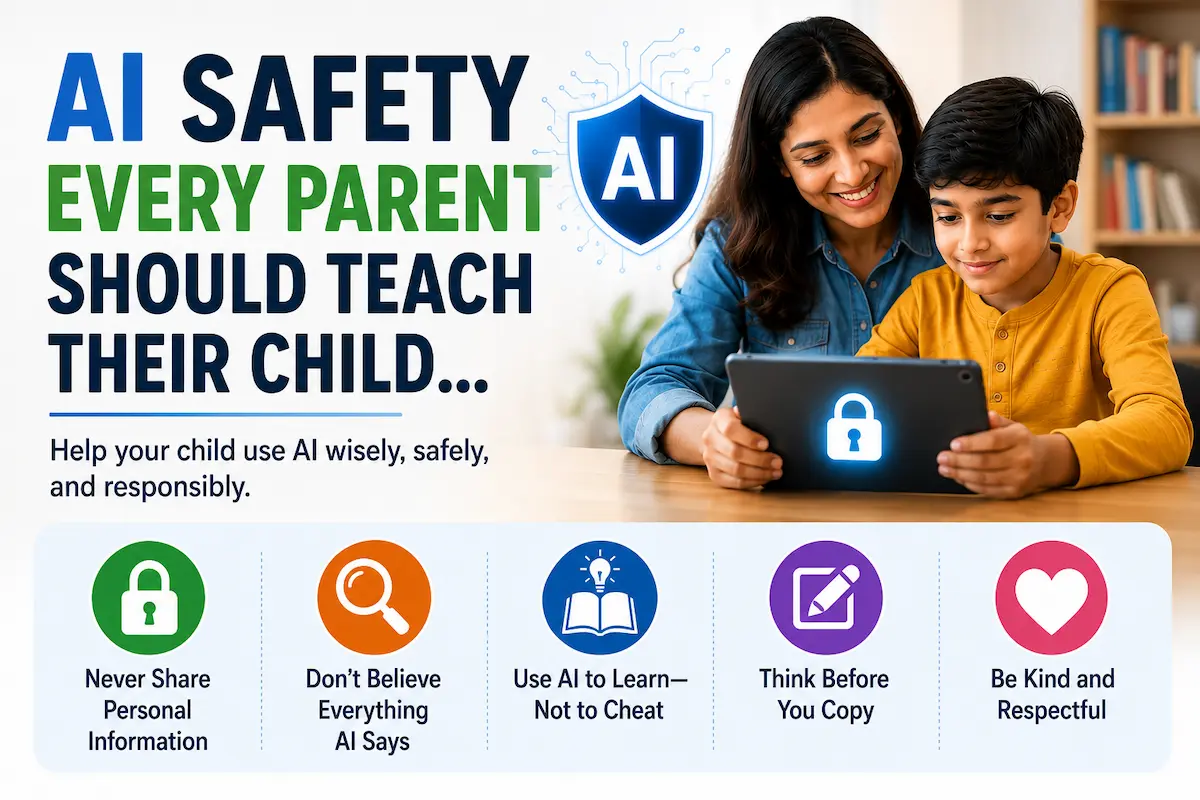
Parents don’t need a 20-page technology policy. Start with five simple rules.
1. Ask First : Ask before using a new AI tool.
2. Protect Privacy : Never share private or sensitive information.
3. Check the Answer : AI can make mistakes.
4. Think for Yourself : Use AI to learn—not to avoid learning.
5. Tell an Adult : Speak up if something feels strange, upsetting, confusing, or inappropriate.
These rules can change as children grow and become more independent. And most importantly, parents should try to follow the same principles themselves. Children learn digital habits by watching adults.
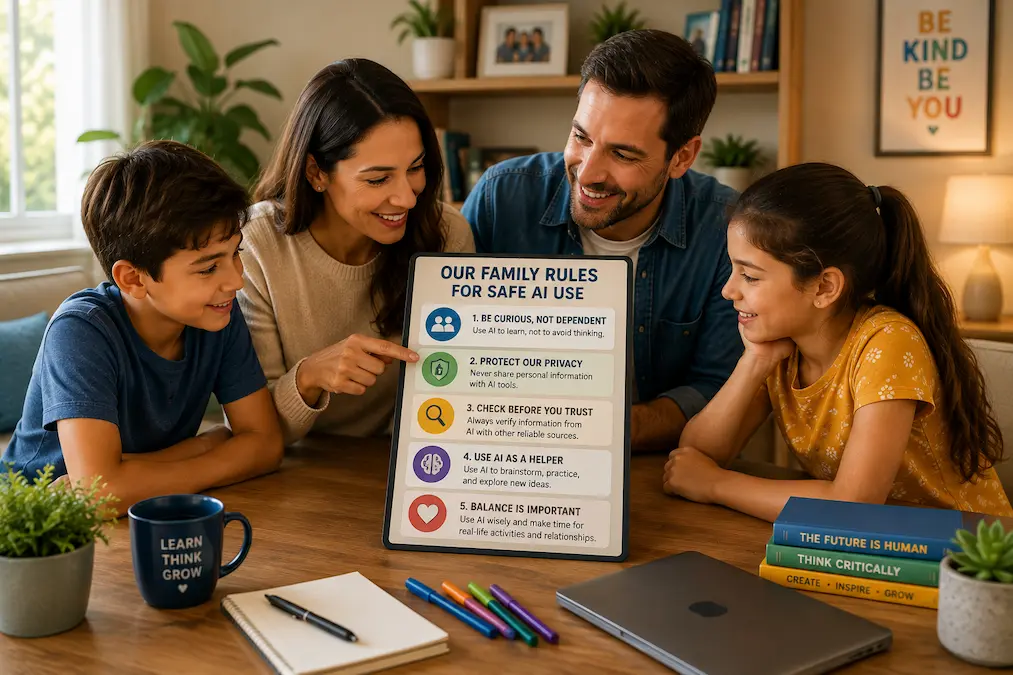
Family Rules for Safe AI Use
Creating simple family rules can help children develop healthy and responsible AI habits.
The Most Important Question Isn’t “How Old?”
Instead of asking only:
“What age should my child start using AI?”
ask:
“What does my child need to know before using AI?”
A responsible child with strong digital judgment may be better prepared than an older child who doesn’t understand privacy, misinformation, or responsible use.
And even when a child is ready, independence should increase gradually. AI literacy isn’t a one-time lesson. It is something children will continue developing as technology changes.
What Parents Can Do Today
You don’t need to become an AI expert tonight. Start with one conversation.
Ask your child:
“Have you ever used an AI tool?”
Then ask:
“What did you use it for?”
Listen without immediately judging. That conversation may teach you more about your child’s digital world than you expect.
And it can be the beginning of something even more important: teaching your child how to use powerful technology with wisdom, curiosity, and responsibility.